

The Two Gentleman of
Verona Shakespeare Santa Cruz, 1999
Robert Hurwitt - San Francisco Chronicle
Petruchio: spouse-abusing brute or misunderstood shrew-tamer? Is
Shakespeare’s ever-popular The Taming of the Shrew an outdated piece of
misogyny or—seen in its proper context—a marital bargain between misfits? And what kind of marriage did
Kate and Petruchio make? Something like that of, say, the vituperative perpetual warfare of George and
Martha in Edward Albee’s Who’s Afraid of Virginia Woolf?
Such questions—and many more—achieve vital immediacy this summer at
Shakespeare Santa Cruz. Artistic Director Paul Whitworth is back at the helm after a two-year
sabbatical, during which the company mounted atypically desultory seasons, and he's put together one of
the group's strongest seasons ever.
Welcome back, Whitworth.
It’s not just that all three shows are beautifully mounted and invigoratingly
directed and performed—though it certainly helps that Whitworth is back onstage and has brought back
three of the most creative directors from past seasons, including former artistic directors Danny Scheie
and Michael Donald Edwards. Above all, it’s the inspired combination of plays Whitworth has selected,
pairing Shakespeare’s Shrew with John Fletcher’s nearly contemporary
response to it, The Tamer Tamed, and marrying them to Albee’s modern take
on embattled matrimony.
Whitworth isn’t the first to pair Shrew with
Tamer. … The Royal Shakespeare Company made international theater headlines
with tandem productions, also well-received in NewYork. Whitworth, an RSC veteran, improves upon the
idea by eschewing the changes the RSC made to Tamer—and by adding Woolf to the mix. The plays resonate off each other to complex and provocative
effect.
Fletcher responded to Shrew by having a widowed
Petruchio (the solid, smoldering, soulfully macho Robertson Dean in both plays) decisively tamed by a
clever second wife, Maria (a playfully sexy but resolute Blaire Chandler, who also plays a frumpy,
resentful Kate awakened into radiant sexuality in Shrew). He also, in
passing, tells us how bad a match resulted from the first play (Petruchio still has Kate nightmares),
referring to nonstop wrangling that sounds rather like Albee's George and Martha. In this context, it
looks as if Albee may have had the same idea. His couple argues about the moon in a manner strikingly
reminiscent of Shrew.
Thematic connections are reinforced by setting the Renaissance plays in
post-World War II America—about a decade before Woolf—on Kate Edmunds’
two-tiered set in the festival's redwood-shaded amphitheater. B.Modem's sly, tongue-in-cheek ‘50s
costumes establish the period, with the same cast in equivalent roles in both plays. Gregg Coffin's
buoyant, jazzy score for Shrew gives way to Scheie’s camp-fest of ‘50s pop
tunes in Tamer (including songs from—what else?—Kiss
Me Kate).
With costumes, actors and characters establishing clear links, directors Tim
Ocel and Scheie take different but complementary approaches. Ocel’s slightly abridged Shrew (he cuts the awkward scenes about the drunk for whom the play is staged)
is relatively straightforward. Sharply paced and played with impeccable comic timing, it draws most of
its humor from the script, making use of its modern-dress format for occasional inventive flourishes and
fleeting pop references.
Ocel’s primary focus is on re-imagining the Kate-Petruchio relationship—and
the result is intriguing. Rather than a fiercely independent or haughty Kate, Chandler depicts a
self-hating spinster, stewing in jealousy over her scheming sister Bianca’s popularity with men
(including their father). Dean's Petruchio is the opportunistic soldier of fortune as war-fatigued
veteran (in uniform), seeking to make the best of a mercenary match and falling for Kate—and she, much
to her surprise, for him—in the process.
Ocel makes the taming less monstrous by having Petruchio suffer as much as
Kate, with Dean's Robert Mitchum-sad eyes reflecting the strain. The result, in Chandler's knowing
recital of Kate's big submission speech, and Dean's overwhelmed reaction, is unusually satisfying and
touching. And Dean’s Petruchio carries over nicely into Scheie’s Tamer
with a shell-shocked, hollow bravado ripe to be tamed by Chandler's savvy, quick Maria.
Most of the key supporting roles provide clever continuity as well. Morgan
Davis’ man-manipulating Bianca from Shrew nicely segues into Fletcher's
militant feminist Bianca, Maria's main ally (while Sarayu Rao is a sweet dissembler as Maria’s sister,
in Fletcher's version of the Shrew subplot). Patrick Kerr’s sardonically
querulous old lechers, Mike Ryan’s comically conflicted Tranios, Cody Nickell’s love-struck swains and
Tommy Gomez’s comically resentful servants add evocative through lines. …
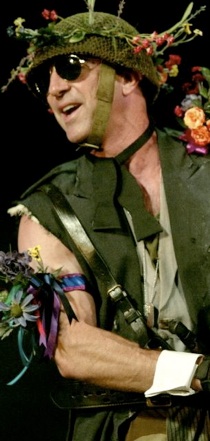
Robertson Dean
The Taming of the Shrew
Shakespeare
Shakespeare Santa Cruz
2004
Photo: r.r. jones